 TripleTrail
Replaces Fuseki and RDF4J
Same URLs, admin API and protocols. Your clients keep working.
Open-source RDF triple store
A complete SPARQL server for any knowledge graph, a drop-in for Jena Fuseki and RDF4J clients, with geometry, routing and an AI assistant built in.
Open source under Apache-2.0. Read the source on GitHub →
One database, three questions
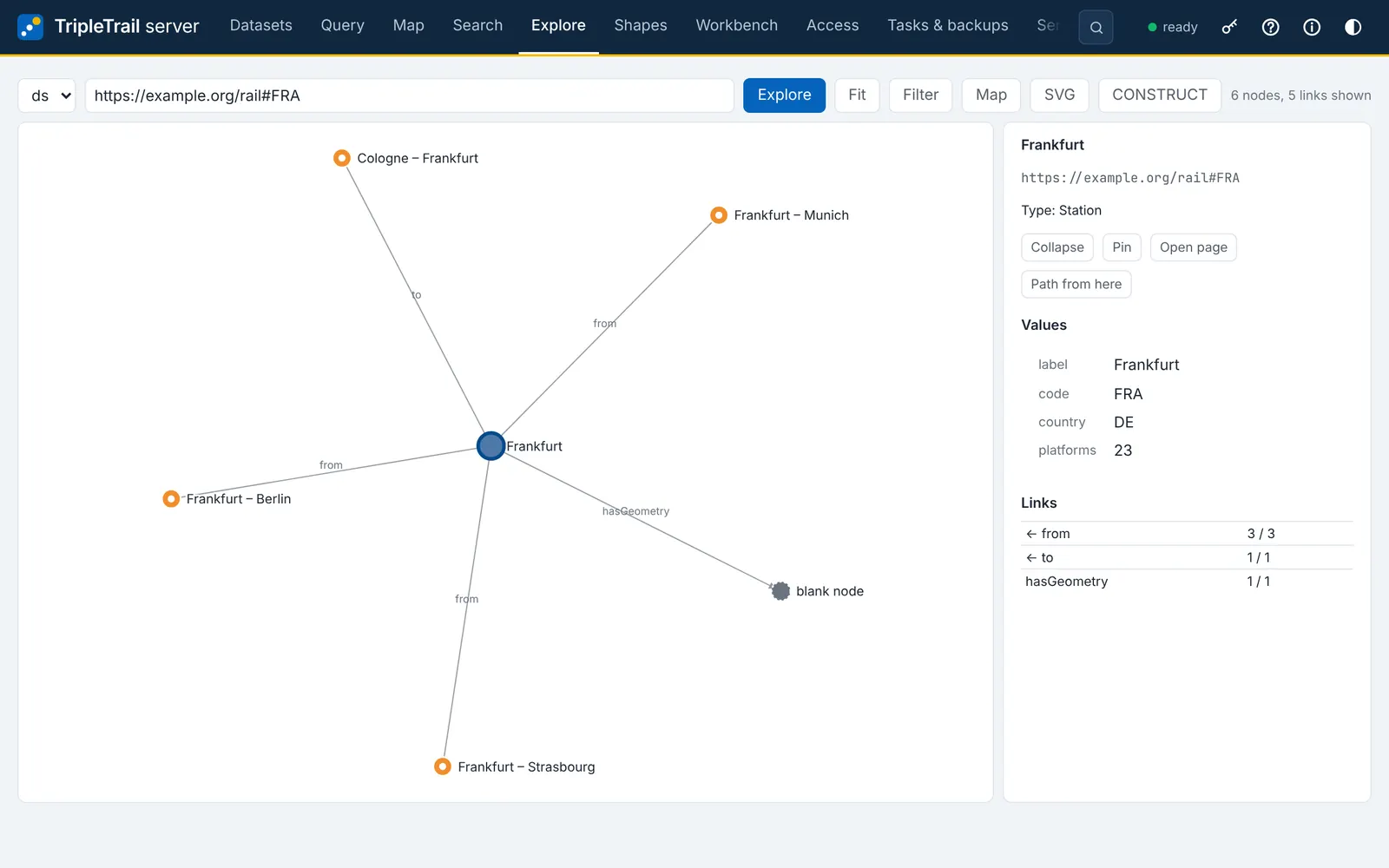
graph1 / 3
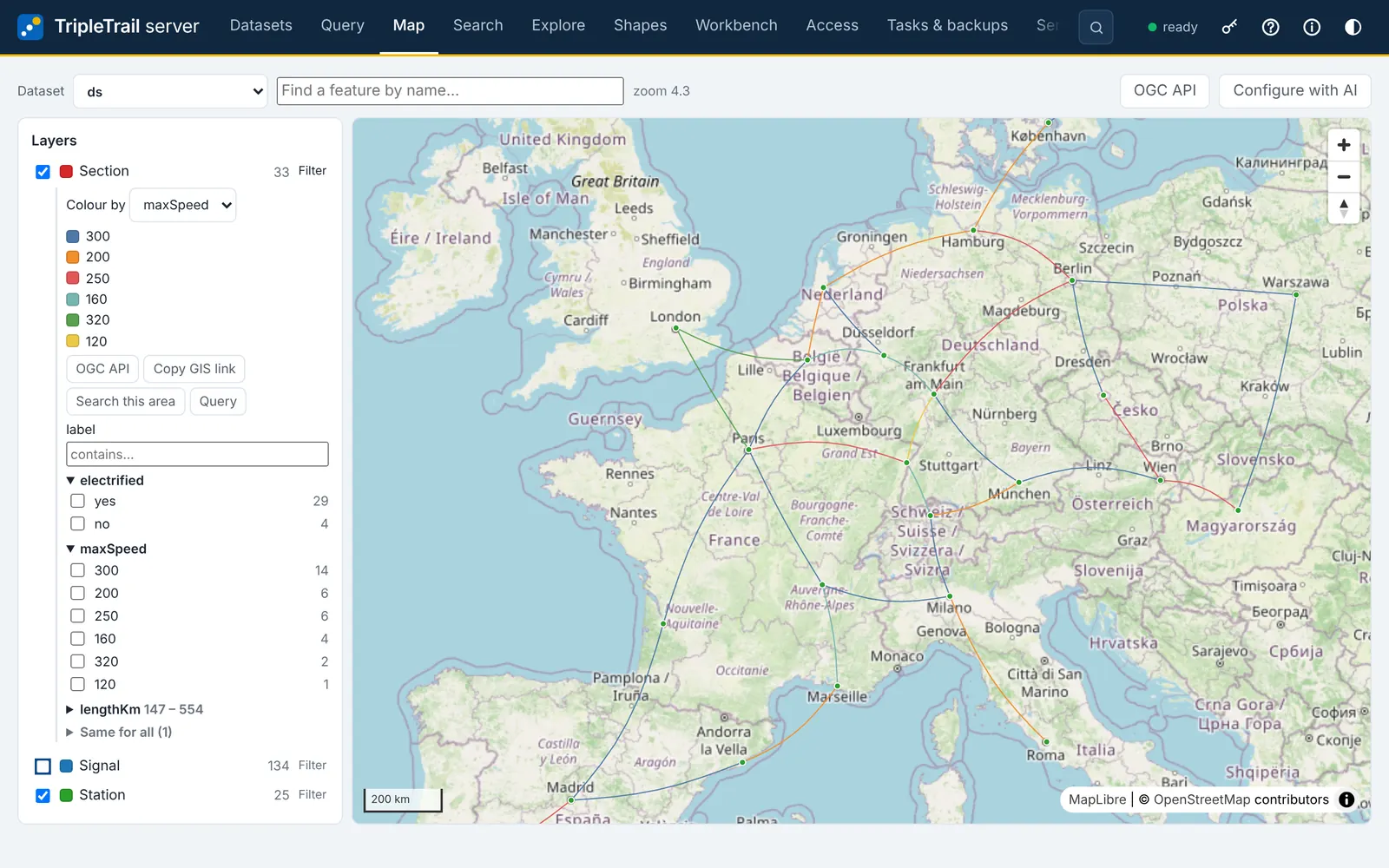
map2 / 3
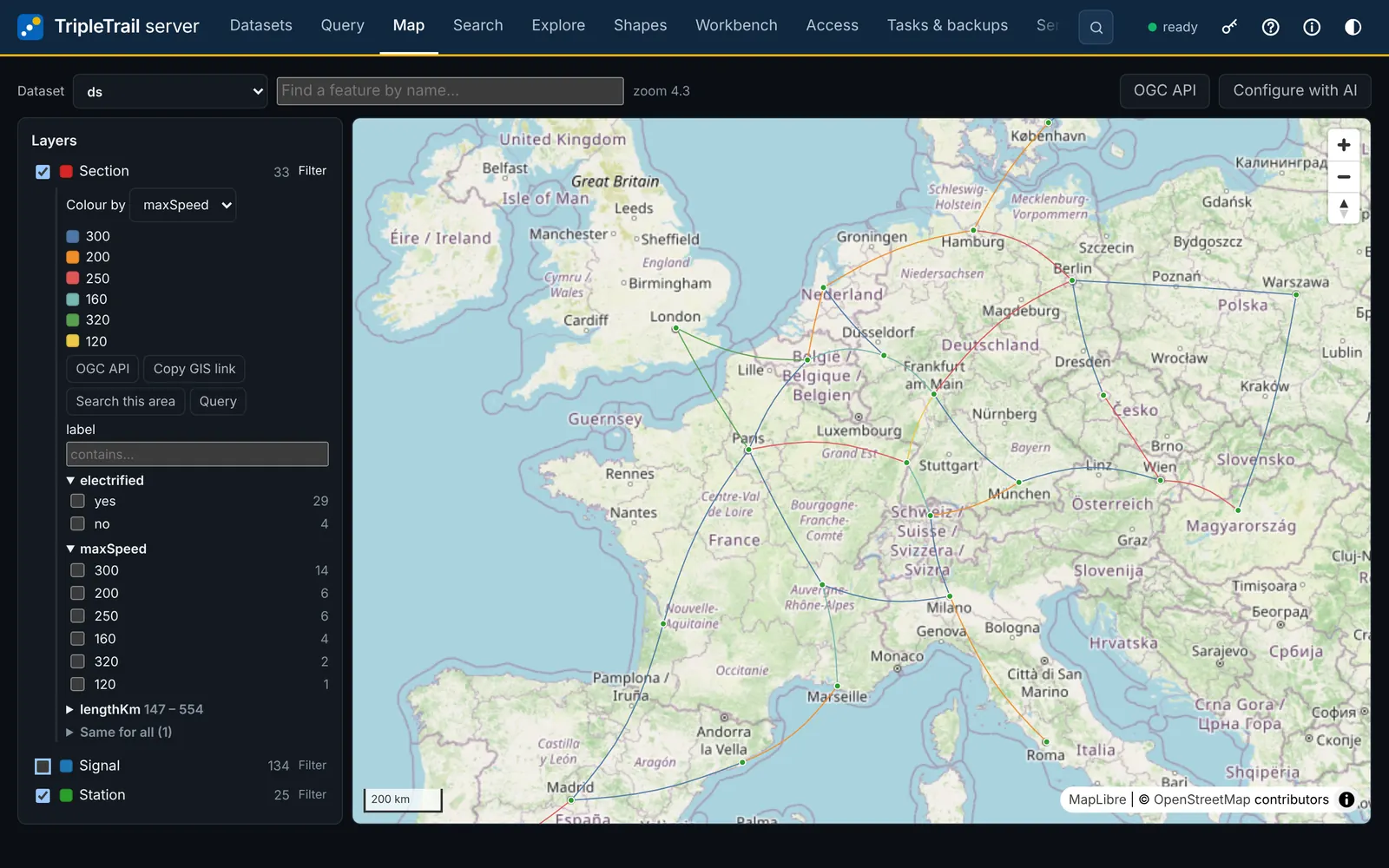
Move over the map to run a spatial query
route3 / 3
Who it is for
TripleTrail is a general-purpose triple store first. Organisations that manage physical networks get the most out of it, because their questions are about place and connection.
On Jena, RDF4J or GraphDB and want a faster store with validation and reasoning, map or no map.
Infrastructure registers like RINF, topology, kilometre posts and routing over the real track.
Linear referencing, restrictions per vehicle type, detours and travel-time areas.
Electricity, water and telecom grids. CIM and CGMES are already RDF.
Terrain, infrastructure and transport networks for military mobility and logistics. Runs on your own servers, air-gapped if needed.
Want to see this on your own network?
AI, on your terms
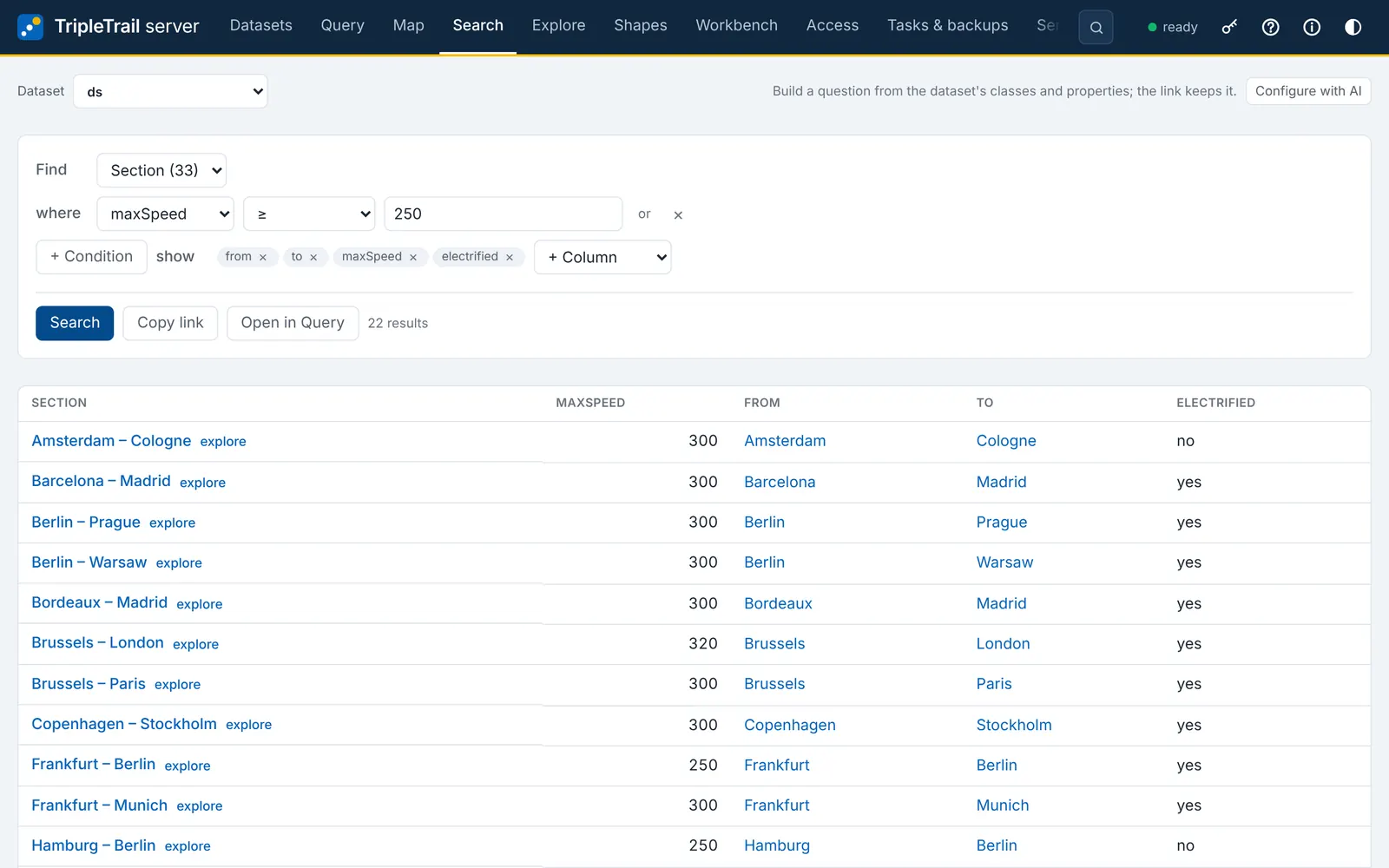
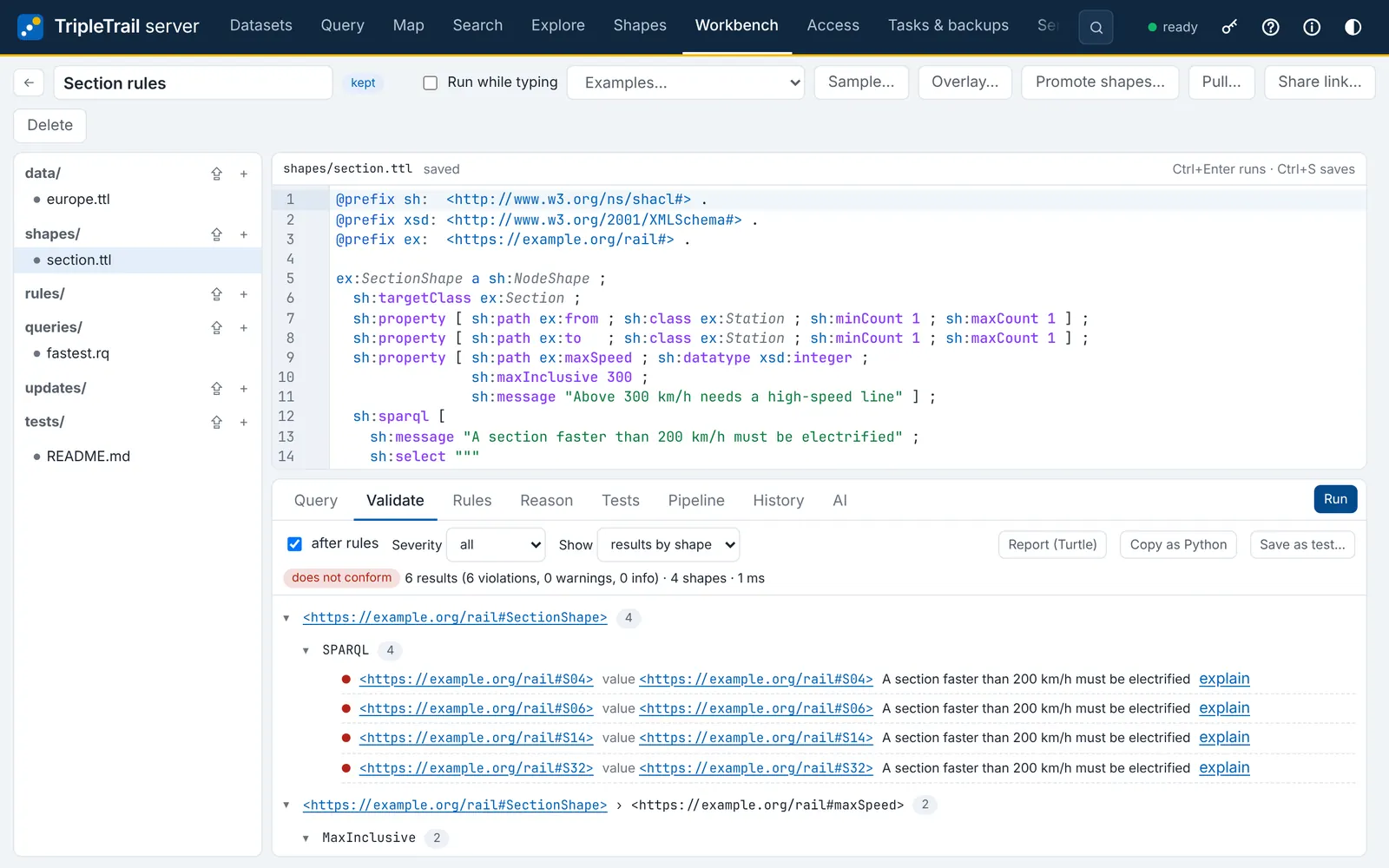
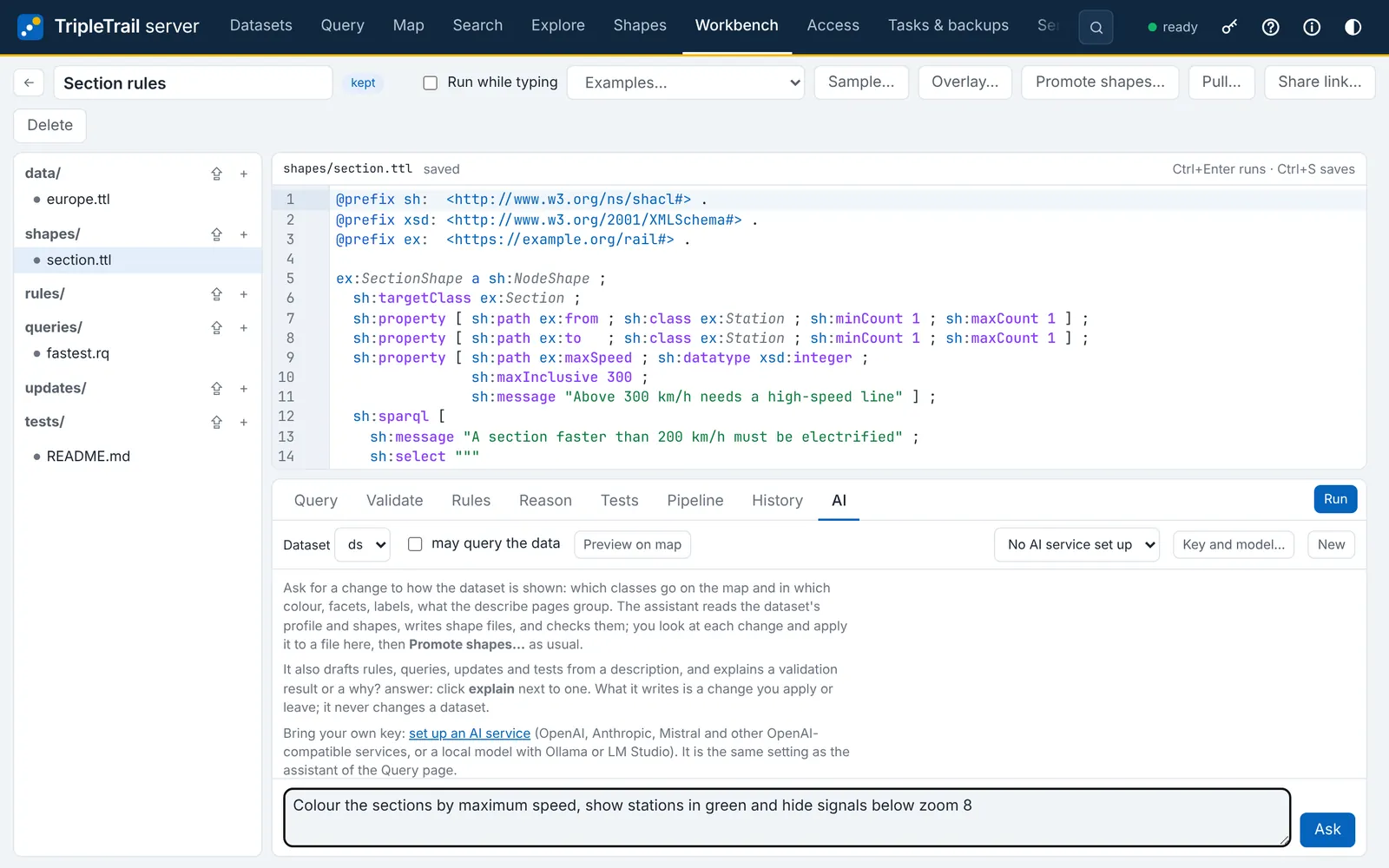
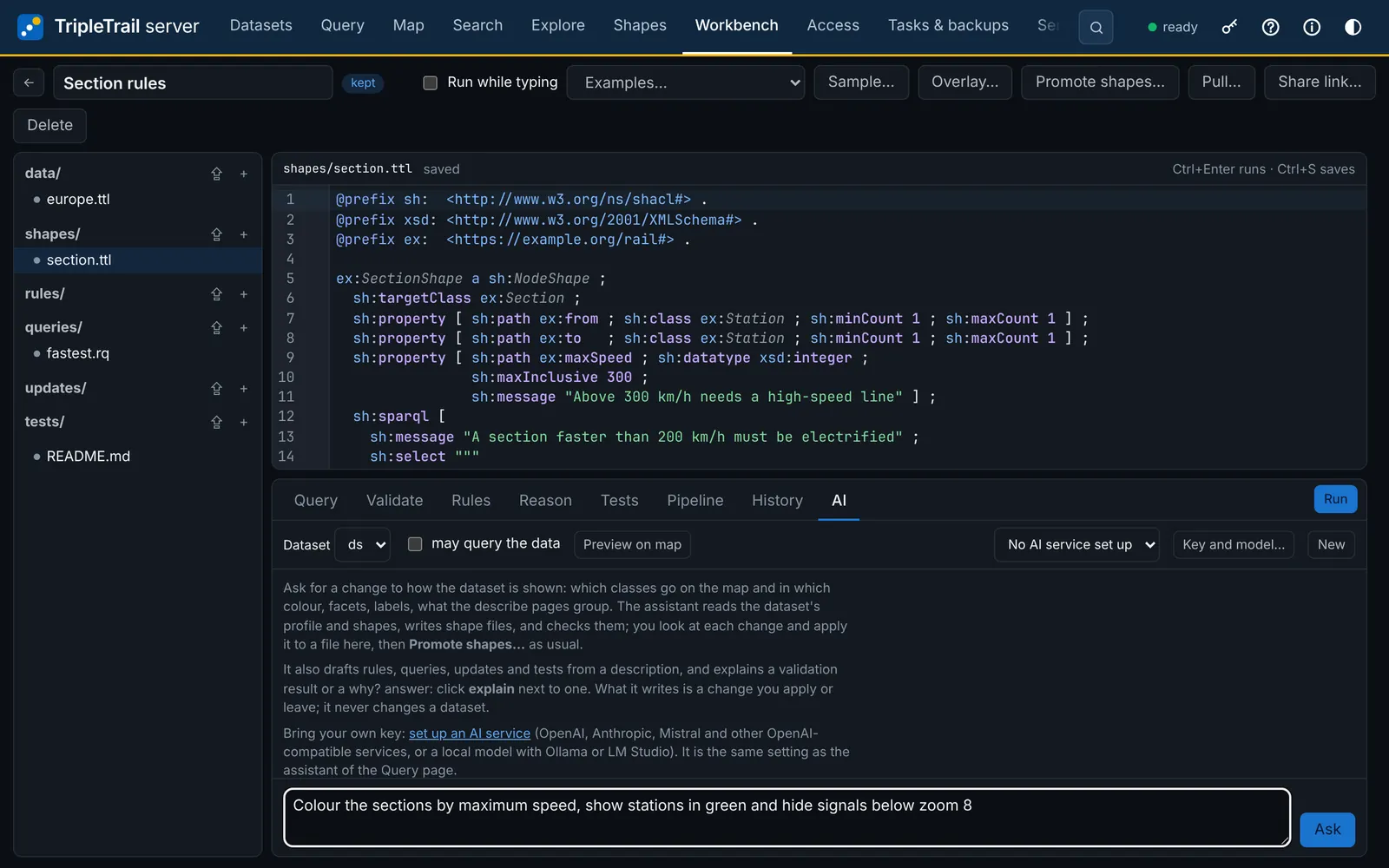
The assistant writes the SPARQL, runs it when you allow it and shows the result on the map. In the Workbench it sets up maps and validation shapes from a sentence. You choose the model: an EU provider such as Mistral or Scaleway, any OpenAI-compatible service, or a local model in Ollama. The key stays in your browser.
Everything in one binary
Same URLs, admin API and protocols. Your clients keep working.
GeoSPARQL 1.1, PostGIS functions, linear referencing.
Shortest paths, isochrones, constraints, contraction hierarchies.
SHACL, SHACL rules, RDFS and OWL 2 RL, kept up to date.
OGC API Features and vector tiles for QGIS and web maps.
CSV, Excel, JSON, XML, Shapefile and databases to RDF.
The complete picture
Your data goes in as files, spreadsheets or database tables. TripleTrail stores, checks and links it, and serves it to every tool your teams already use, plus a set of web apps in the browser.
Measured, not claimed
7.6× the query mixes per hour of Oxigraph, the next store
query mixes per hour, higher is better
log scale
* ran a lighter mix that skips 2 of 12 query types.
26× faster than pgRouting on the same Dijkstra route, and 5.1 ms with contraction hierarchies
milliseconds, lower is better
log scale
pgRouting has no contraction hierarchies to compare with. PostGIS stays faster on simple box and nearest-neighbour lookups.
All benchmarks, including where others win
Run the benchmark on your own data
Open source · EU hosting available
Bring a sample. We load it, draw the map, build the network and answer your hardest question.